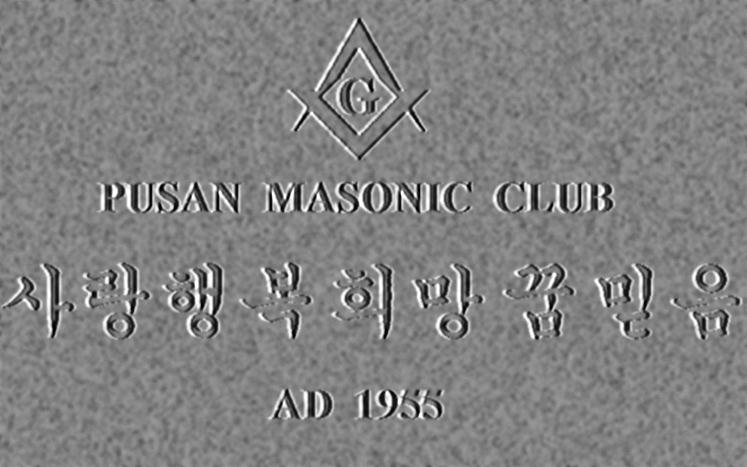
 There are four Masonic Lodges in the Republic of Korea: Han Yang Lodge 1048, Lodge Pusan 1675, and Lodge Harry S. Truman 1727, each chartered under the Grand Lodge of Scotland. MacArthur Lodge 183 holds its charter from the Grand Lodge of the Philippines. The only known Masonic cornerstone in the country is at the Pusan (Busan) Children's Charity Hospital. Masonic members of the US Armed forces, the hospital's sponsor, placed the cornerstone in 1955.
Tuesday, June 5, 2012
The Only Korean Cornerstone
There are four Masonic Lodges in the Republic of Korea: Han Yang Lodge 1048, Lodge Pusan 1675, and Lodge Harry S. Truman 1727, each chartered under the Grand Lodge of Scotland. MacArthur Lodge 183 holds its charter from the Grand Lodge of the Philippines. The only known Masonic cornerstone in the country is at the Pusan (Busan) Children's Charity Hospital. Masonic members of the US Armed forces, the hospital's sponsor, placed the cornerstone in 1955.
Monday, June 4, 2012
The Lowly Paper Cup Saved His Life
 Elmer Zebley Taylor (1864-1949), Lodge unknown, invented the paper cup. He marketed his invention under the brand name Kleen Kup through his company, Mono Containers, Ltd., making a fortune. Mono Containers had plants in ten countries so Brother Taylor resided in Europe, but spent summers in New Jersey. Making that trip for the summer of 1912, Brother Taylor booked a cabin on the Titanic. His substantial wealth enabled him to travel in a prime first-class cabin, located close to the main deck area. When the ship struck an iceberg, Brother Taylor reacted immediately. He and his wife Juliet reached the lifeboats before the crew began prohibiting men to board them. As a result, he boarded and became one of the very few adult males to survive the tragedy. In a way the lowly paper cup, which had enabled him to ammass the wealth to afford that prime cabin close to the main deck and lifeboats, saved his life.
Saturday, June 2, 2012
The Expatriate Patriot

Sometimes known as the forgotten hero, here are a few facts about the Marquis de La Fayette (September 6, 1757 – May 20, 1834), a Frenchman who secured his country's assistance during the American Revolution, an act which very possibly ensured the defeat of the British and the birth of a new nation. He was so taken by this new country and its concepts of democracy and equality, he once remarked, "From the moment I heard the name America, I loved it."
● His full name is Marie-Joseph Paul Yves Roch Gilbert du Motier, Marquis de La Fayette.
It is unclear where he was initiated, but certain he was a Freemason. He may have been a member of Loge La Candeur of Paris, and may have been a "Lewis" Mason.
● More than 50 towns in the US are named after him.
● He was married at the age of 16; his bride Adrienne was 14.
● Marie Antoinette mocked him when she first met him.
● He was only 19 when he became a major-general.
● He commanded colonial troops in 1777 under conditions so poor, they resorted to eating their shoes.
● He warned General Washington when opposing forces in congress wanted to remove him, gaining Washington's trust for a lifetime.
● Washington had no son; Lafayette had no father; Washington considered Lafayette a surrogate son.
● He named his son Georges Washington de La Fayette (1779–1849) in honor of his friend.
● Using the slave Armistead to infiltrate Cornwallis' camp he outsmarted and defeated the general.
● When he took the fort at Yorktown, his troops' guns were empty. He used only fixed bayonettes to win the battle.
● He ordered his band to play Yankee Doodle at Yorktown while the British surrendered their arms.
● When the slave James Armistead was freed he changed his name to James Armistead Lafayette.
● He urged Washington to make the experiment in democracy complete by removing the taint of slavery from the United States.
● He also asked the French ministry to free the slaves of Guyana.
● With Thomas Jefferson, he drafted the Declaration of the Rights of Man.
● Imprisoned during the French Revolution, he gained his release as a result of the pleadings of George Washington.
● James Monroe invited him back to the US to celebrate the 50th anniversary of the American Revolution. Eighty thousand people (2/3 the population of New York) greeted him.
● In the US, he visited all 24 states declaring, "Someday America will save the world."
● He stopped his parade in Virginia when he recognized James Armistead Lafayette in the crowed and the two had a tearful reunion.
● On his trip to America, he was made an honorary member of the Grand Lodge of Missouri, as well as many other Masonic bodies. He is said to have more Masonic honors than any Freemason before or since.
● When he died, they found a locket around his neck carrying a picture of Adrienne, who had preceded him in death.
● He removed soil from a spot near Washington's tomb and took it with him back to France. Today, his body rests in that American soil.
The Marquis de La Fayette was such a strong advocate of human rights and the democratic principles embodied by the new United States that the French writer, politician and historian François-René de Chateaubriand said of his legacy, "Monsieur de Lafayette had only one idea; happily, it was the idea of the century."
Friday, June 1, 2012
Fredericksburg Lodge

Thursday, May 31, 2012
Cannonball Paul

Thanks to Todd Creason for the tip on Brother Paul. One of Todd's articles was featured in the current "Missouri Freemason" and, seeing they had the same name, "Cannonball Paul" contacted Todd. They're not sure they are related but they are Brothers nonetheless. Todd's article on Brother Paul can be found on his blog, The Midnight Freemasons
Wednesday, May 30, 2012
Thayendanegea

Tuesday, May 29, 2012
Brother Nicholas' Recruiting Program

Subscribe to:
Posts (Atom)